Now that my book 'The Siren of Southsea' is completed I wanted to start displaying it locally in the Portsmouth area to spark interest in my project and get people engaged. As my narrative is based in Portsmouth, I wanted to contact local shops/museums/galleries to display the book in. I think it will do well and be more appealing to the local community because they can relate to the area.
The first place it's exhibiting is in the University of Portsmouth Library. I filled one of the glass display cabinets with one of my final books and my older mockup watercolour book. As well as these I included prints of my original screen prints and prints of the watery background to place the books on, I think this makes the display look more interesting and enhances the ocean theme. I also included a description of both books, the poem in the final book and my contact details.
The cabinet is by the entrance of the library so is a good spot for everyone to see it as they walk past. I am happy with the display as I think it is quite eye catching with the block of blue colour. Everyone who visits this venue either work, live or study in Portsmouth so have close ties to the area so I am hopeful that they will find my work interesting.
The next place I wanted to display my book was at The Portsmouth Museum. I emailed them and they were very interested in my work but unfortunately they couldn't accommodate it:
So as suggested, I have contacted Aspex Gallery and am waiting for a response to see if they would be interested in displaying or selling my book.
Tuesday, 10 July 2018
Tuesday, 5 June 2018
Belly Bands for the Books
Making bands to go round my concertina books has been the final stage of making them and I am very pleased with the outcome. I used an old map of Portsmouth so the audience had an idea of setting even before opening the book.
To start with I just experimented making the belly bands out of normal printer paper by printing the map image onto it and cutting it to different sizes. This allowed me to keep costs low as I didn't pay for as much card (which I made the real versions out of). I tried both a thicker and thinner band but in the end I preferred the thinner. Although you can see more of the map on the thicker band, I feel it over powers the whole book and takes away from the title.
I decided to join the ends of the band together with string. This was because I didn't want to make a solid band help by glue or tabs as I want the audience to interact with the band more and realise what is on it. Having to pick it up and spend time removing it may encourage them to look closer. Belly bands often are forgotten about once taken off and get lost, so going through the act of having to untie and remove it will hopefully encourage readers to remember to tie it back up afterwards. I used PVA glue to attach the string to the band. I also really like the look of the string, it has that imperfect feel to it and is more suited to the time in which my story is set compared to more modern materials such as velcro which I considered using. I think velcro would have looked out of place considering the look and feel of the rest of the book.
I also experimented with cutting the map length ways or across the width. I went with the width of the paper so I could easily crop the bottom of Portsmouth which included Southsea. This way the audience can put the title of the book to a visual place and help them connect better with the story. On one of the early experiments I wrote 'made in Portsmouth Uk' and 'Edition 1/3' on the front of the belly band to see how text would look onto of the map. I was unsure about it, thinking that it didn't look very good as it got lost in the map and took away the impact that the map had. I think I will find another way to include this information in the book, whether it be a book mark or writing it on the inside of the cover.
Overall I am really happy with how the map looks as a belly band, and how it completes the whole look of the book. I think the colours go well with the cover as well as the images inside. My next task will be getting it out in the public domain and getting people to interact with it.
To start with I just experimented making the belly bands out of normal printer paper by printing the map image onto it and cutting it to different sizes. This allowed me to keep costs low as I didn't pay for as much card (which I made the real versions out of). I tried both a thicker and thinner band but in the end I preferred the thinner. Although you can see more of the map on the thicker band, I feel it over powers the whole book and takes away from the title.
I decided to join the ends of the band together with string. This was because I didn't want to make a solid band help by glue or tabs as I want the audience to interact with the band more and realise what is on it. Having to pick it up and spend time removing it may encourage them to look closer. Belly bands often are forgotten about once taken off and get lost, so going through the act of having to untie and remove it will hopefully encourage readers to remember to tie it back up afterwards. I used PVA glue to attach the string to the band. I also really like the look of the string, it has that imperfect feel to it and is more suited to the time in which my story is set compared to more modern materials such as velcro which I considered using. I think velcro would have looked out of place considering the look and feel of the rest of the book.
I also experimented with cutting the map length ways or across the width. I went with the width of the paper so I could easily crop the bottom of Portsmouth which included Southsea. This way the audience can put the title of the book to a visual place and help them connect better with the story. On one of the early experiments I wrote 'made in Portsmouth Uk' and 'Edition 1/3' on the front of the belly band to see how text would look onto of the map. I was unsure about it, thinking that it didn't look very good as it got lost in the map and took away the impact that the map had. I think I will find another way to include this information in the book, whether it be a book mark or writing it on the inside of the cover.
Overall I am really happy with how the map looks as a belly band, and how it completes the whole look of the book. I think the colours go well with the cover as well as the images inside. My next task will be getting it out in the public domain and getting people to interact with it.
Tuesday, 29 May 2018
Binding my book
After finally folding my 3 metres of book into a concertina, I decided to make my hardback covers, print the titles onto them and bind everything together to make my 3 books! I managed to print out 4 copies of the book, using one as practice and then the rest to make an edition of 3 books.
I made the book covers out thick card and book binding cloth, and joining everything together with PVA glue. I left a 2cm border of cloth around the card to fold around it, making sure that when I glue the page to it that there was none of the bare card showing. I used the same coloured orange cloth as my first concertina book attempt as I thought it worked well as a contrast with the blue inside. This has been enhanced even more in my final finished books as the colours inside are a lot stronger.
Because of the nature of the folds in the book, when finished and pushed together, the pages create a layered effect to one side so the covers aren't directly behind each other. I did this so it looks more like a wave, linking with the waves inside the book, giving the audience a sense of what lies within before even opening the book.
I screen printed the title of my book onto the covers, after research I found this would be the easiest way to produce 3 covers quickly. I really like how they haven't printed pristinely because of the grain of the cloth. I think this adds to the character and older feel I wanted to give to the book.
I made the covers nearly the exact same size as the pages so when spread out it stands up fine on its own. My first concertina I made struggled to stand freely because the pages didn't touch the table as the covers were too big. This time I made sure the pages were glued at the bottom of the covers so everything would touch the table to stand up.
The final touches would be to create a band to go round the book, holding the pages together when its not standing up. Im planning for this band to be made from an old map of Portsmouth.
I made the book covers out thick card and book binding cloth, and joining everything together with PVA glue. I left a 2cm border of cloth around the card to fold around it, making sure that when I glue the page to it that there was none of the bare card showing. I used the same coloured orange cloth as my first concertina book attempt as I thought it worked well as a contrast with the blue inside. This has been enhanced even more in my final finished books as the colours inside are a lot stronger.
Because of the nature of the folds in the book, when finished and pushed together, the pages create a layered effect to one side so the covers aren't directly behind each other. I did this so it looks more like a wave, linking with the waves inside the book, giving the audience a sense of what lies within before even opening the book.
I screen printed the title of my book onto the covers, after research I found this would be the easiest way to produce 3 covers quickly. I really like how they haven't printed pristinely because of the grain of the cloth. I think this adds to the character and older feel I wanted to give to the book.
I made the covers nearly the exact same size as the pages so when spread out it stands up fine on its own. My first concertina I made struggled to stand freely because the pages didn't touch the table as the covers were too big. This time I made sure the pages were glued at the bottom of the covers so everything would touch the table to stand up.
The final touches would be to create a band to go round the book, holding the pages together when its not standing up. Im planning for this band to be made from an old map of Portsmouth.
Thursday, 17 May 2018
Printing has Begun
I have now begun the printing process of my book. After piecing everything together in InDesign, the book totalled 330cm! Over 3 meters long so I had to get it printed on the large format printer. I have never printed anything this big so was unfamiliar with process, but the support desk were very helpful! It was good to challenge myself to create something this long as now I have learnt a new skill I can use in future projects.
I went for a heavier paper as I wanted the pages to feel high quality and that they had substance to them. The technician advised me to go for a thinner paper as it would be easier to fold back up into a concertina and he said the ink might crack on the folds of thicker paper. But I stuck to my guns and went with the heavy duty paper.
I didnt have much difficulty folding, apart from the length made it a bit fiddly. I managed to print 4 copies of the book on the width of the 3 meter piece of paper. This gave me room to experiment with a couple. The first one I folded looked very uneven, I wasn't very accurate with lining it up to the rest of the book. The second attempt went better but I discovered that the column I set out in InDesign cant have been all the same size as the width of the book when folded up was different. The height of the book was the same and very neat but the width was a bit jagged and uneven. At first I was annoyed as it didnt look neat. But then I thought about my theme of perfection and how my book illustrates that you don't have to be perfect. So maybe this folding style would suit the book even more?
Thursday, 10 May 2018
Drama in Waves
Adding extra pages of waves into my book has made me conscious of the drama and energy that they can bring. And how I want to use this in my work to communicate to the audience.
I recently took another trip down to Brighton to study the sea and the waves in real life, as well as visiting a different gallery that had some great wave paintings.
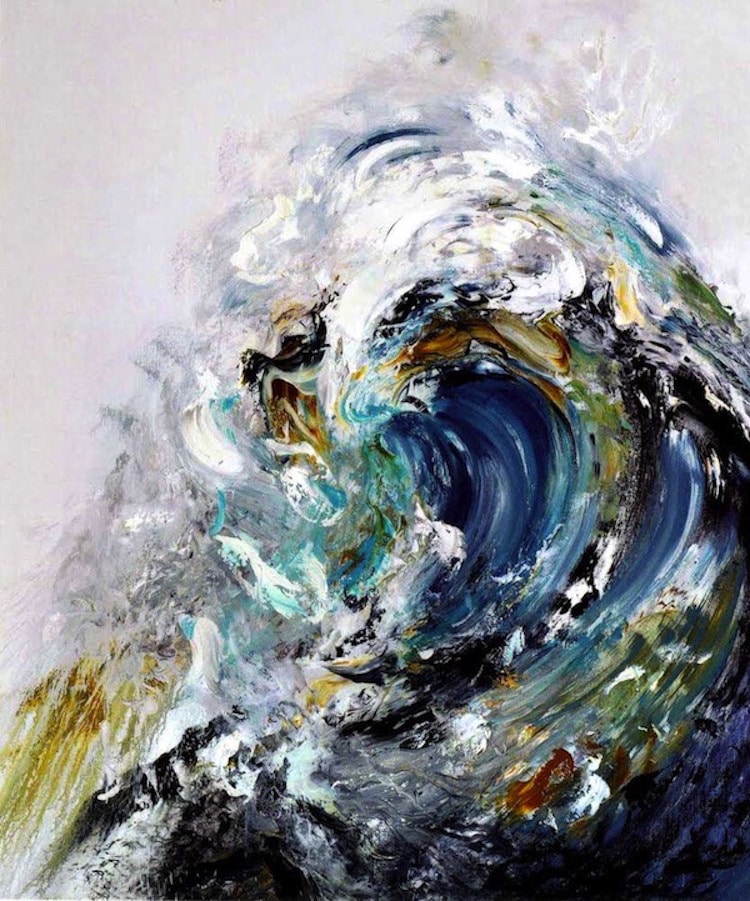
I think the raw energy of the ocean captured in the techniques are great and remind me of artist Maggie Hambling who's work I have previously seen in Suffolk:
Another artist that includes dramatic waves in his work is Hokusai:
These examples inspired me to experiment more with the images I was having trouble with getting to flow properly. If I couldn't make them flow throughout the book, maybe I should make the wave 'spacer' pages more dramatic to emphasise the emotions in my illustration.
I make the waves go from calm to choppy. But looking at this screenshot now, I feel I could emphasise this even more in the following images in the book.
Lynda.com
As my current project has moved on from traditional processes to more of the digital editing, I have been using Photoshop and InDesign more and more. Although familiar with both to some extent, I have had to teach myself some new skills in order to achieve my desirable outcomes. For this I been doing a lot of research on Lynda.com. They have many high quality video tutorials for different softwares including Adobe. From this, I have decided to take exams to become Adobe certified in Photoshop, InDesign and hopefully Illustrator if I have time. Lynda.com has videos on how to prep for these exams and what you need to know for them. This website has been of great value to my research for this project as well as helping me get recognised more in the creative industries with my Adobe Certifications.
Wednesday, 9 May 2018
Wavey Pages
As I mentioned in one of my previous posts, I played around on Photoshop and InDesign to create spacer pages for my book in-between my illustrations to make the whole thing flow better.
I am happy with the majority of what I have created but I am struggling with the middle image and how to space it as it has no water within the illustration which makes it hard to link with the others.
To create these spaced pages I used the backgrounds I had already created and Photoshopped them into wave forms to join and link the images:
I used backgrounds with similar colours to transition them gradually.
The part I am having trouble with is this:
I was trying to figure out a way to link the white spaces together in a similar wave format. I experimented with a couple of different ways and so far I am at this point:
I am happier with this version but I feel there is still work to be done and something isn't quite right. I am happier with the right sides flow, but less satisfied with the left side. I will carry on experimenting to see if I can make something more free flowing, if not I may have to consider reorganising the images into a different sequence to make the flow easier.
I am happy with the majority of what I have created but I am struggling with the middle image and how to space it as it has no water within the illustration which makes it hard to link with the others.
To create these spaced pages I used the backgrounds I had already created and Photoshopped them into wave forms to join and link the images:
I used backgrounds with similar colours to transition them gradually.
I was trying to figure out a way to link the white spaces together in a similar wave format. I experimented with a couple of different ways and so far I am at this point:
I am happier with this version but I feel there is still work to be done and something isn't quite right. I am happier with the right sides flow, but less satisfied with the left side. I will carry on experimenting to see if I can make something more free flowing, if not I may have to consider reorganising the images into a different sequence to make the flow easier.
Tuesday, 1 May 2018
Front cover text
For the front cover of my book, I want it to look quite old and traditional. I have decided to make hard covers and cover them with book cloth, with the title screen printed onto it. After talking to the print studio technicians, I found out that screen printing would be the best way to get text onto my book cloth.
I wanted the text to look old and hand written so I looked at a lot of script typography. I was given some scraps of book cloth to experiment on with all the different fonts so I could see which came out best and gave the desired effect:
One of the fonts didn't translate to the printer. I think the most fitting for my project is the last line of text. I used white in these experiments as it would show up better on the dark background colours, for my actual cover, I would like it to be an orangy colour (like the first book I made in the book binding workshop - see previous blog posts) to match with the orange/browns inside the book. I could have the title in blue which would reflect my colour pallet within the book.
I wanted the text to look old and hand written so I looked at a lot of script typography. I was given some scraps of book cloth to experiment on with all the different fonts so I could see which came out best and gave the desired effect:
One of the fonts didn't translate to the printer. I think the most fitting for my project is the last line of text. I used white in these experiments as it would show up better on the dark background colours, for my actual cover, I would like it to be an orangy colour (like the first book I made in the book binding workshop - see previous blog posts) to match with the orange/browns inside the book. I could have the title in blue which would reflect my colour pallet within the book.
Latest Update on Ideas
I had a well needed tutorial today, talking through my ideas and getting opinions on my book so far. From this I have definitely decided on a few solid ideas to take forward in this project. I always find tutorials or just talking to others the most effective way of researching and progressing my ideas.
One of my most prominent worries from the start has been what to include on the back of the concertina as I didn't know if I'd have time to create content for that as well as the main front side of the book. I found out from my tutorial today, as well as looking at other examples of concertina books, that most of the time the backs are blank. This reassured me it is acceptable to have nothing on the reverse side of the book so I can focus my time on the main illustrations. Here are some concertina books based on Portsmouth that I have seen so far:
A lot of them included the architecture of Portsmouth as it has many fantastic buildings, but none of them included mermaids.
Another one of my concerns was how to incorporate maps into the book, as I wanted to include an old map of Portsmouth so the setting would be more apparent to the audience. After experimenting with putting maps and my illustrations together on Photoshop, I decided that I didnt like the look of it as it didnt fit in with the watery style of the rest of the images and stunted the flow of the whole book. Therefore it was suggested that I could make a band for the outside of the book with the map. So the old map of Portsmouth is on the outside of the book, giving the audience a sense of place before even starting the story. This could also be where I have the makers imprint details of the book e.g. limited edition no. 1 of 5, made/publish in Portsmouth etc...
Examples of my experiments:
Since starting to piece the whole thing together on InDesign, I have noticed that because of the different watery backgrounds being right next to each other, it looks a bit blocky. I thought of creating a new page in between each illustration as a 'spacer' page, which would act as a wave joining one watery background to another. This would help with the idea of the ocean and its waves in general to give the book more of the sea vibe, it would also help to show the great space and vastness with the ocean as well by creating more space in the book. I will experiment with this next in hope that it gives a better flow to the book.
The last thing I want to experiment with is whether to have the text of my poem dispersed throughout the images or to have it on its own page near the front of the book. This may work as the poem is quite short and would allow the images to speak for themselves. It would also give the audience chance to interpret the illustrations however they like in relation to the poem instead of me deciding what lines go with what images. In my rough layout of the paper draft I have written the poem alongside the images, but I am leaning ever more towards having the poem on its own.
One of my most prominent worries from the start has been what to include on the back of the concertina as I didn't know if I'd have time to create content for that as well as the main front side of the book. I found out from my tutorial today, as well as looking at other examples of concertina books, that most of the time the backs are blank. This reassured me it is acceptable to have nothing on the reverse side of the book so I can focus my time on the main illustrations. Here are some concertina books based on Portsmouth that I have seen so far:
A lot of them included the architecture of Portsmouth as it has many fantastic buildings, but none of them included mermaids.
Another one of my concerns was how to incorporate maps into the book, as I wanted to include an old map of Portsmouth so the setting would be more apparent to the audience. After experimenting with putting maps and my illustrations together on Photoshop, I decided that I didnt like the look of it as it didnt fit in with the watery style of the rest of the images and stunted the flow of the whole book. Therefore it was suggested that I could make a band for the outside of the book with the map. So the old map of Portsmouth is on the outside of the book, giving the audience a sense of place before even starting the story. This could also be where I have the makers imprint details of the book e.g. limited edition no. 1 of 5, made/publish in Portsmouth etc...
Examples of my experiments:
Since starting to piece the whole thing together on InDesign, I have noticed that because of the different watery backgrounds being right next to each other, it looks a bit blocky. I thought of creating a new page in between each illustration as a 'spacer' page, which would act as a wave joining one watery background to another. This would help with the idea of the ocean and its waves in general to give the book more of the sea vibe, it would also help to show the great space and vastness with the ocean as well by creating more space in the book. I will experiment with this next in hope that it gives a better flow to the book.
The last thing I want to experiment with is whether to have the text of my poem dispersed throughout the images or to have it on its own page near the front of the book. This may work as the poem is quite short and would allow the images to speak for themselves. It would also give the audience chance to interpret the illustrations however they like in relation to the poem instead of me deciding what lines go with what images. In my rough layout of the paper draft I have written the poem alongside the images, but I am leaning ever more towards having the poem on its own.
Tuesday, 24 April 2018
Dorset
Over the Easter break I ventured to Dorset for a few days with my friends for a holiday close to home. I loved the rich history the area had to offer, especially the steam train from Corfe castle to Swanage. Whilst in Swanage I walked past an interesting mermaid figure made from stone balanced on one of the walls. This instantly prompted me to research into whether Dorset has any mermaid folklore of its own. Being just along the coast from Portsmouth, I thought this could be an interesting addition to my project.
I found these two websites that mention the same mermaid sighting on the Dorset coast in 1757, which I thought was interesting as it must be a popular story to be mentioned by two different people.
http://www.britainexpress.com/counties/dorset/countryside/chesil-mermaid.htm
https://www.yopa.co.uk/blog/every-home-tells-a-story-the-legend-of-the-lyme-regis-mermaid/
I love the mystery and uncertainty of old accounts like this, they always spark my imagination and motivate me to continue my research and illustrations of mermaids.
I found these two websites that mention the same mermaid sighting on the Dorset coast in 1757, which I thought was interesting as it must be a popular story to be mentioned by two different people.
http://www.britainexpress.com/counties/dorset/countryside/chesil-mermaid.htm
https://www.yopa.co.uk/blog/every-home-tells-a-story-the-legend-of-the-lyme-regis-mermaid/
I love the mystery and uncertainty of old accounts like this, they always spark my imagination and motivate me to continue my research and illustrations of mermaids.
Tuesday, 17 April 2018
Bringing the Mary Rose into my book
As my current project is going to be set in Tudor Portsmouth, I wanted to include something iconic from that time era so the audience can recognise it quicker. After a visit to the Mary Rose museum at Portsmouth historic dockyards, I was inspired and decided to include it in my work. It gave me the idea to have a sailor character alongside my mermaid, as well as basing my story in The Solent where the ship sank. Nobody knows for sure how it sank either, so combining this with mermaids makes for a great story in my eyes.
I want to have the image of the Mary Rose at the start of my book, maybe alongside an old map of Portsmouth or overlaying each other. This would set the scene so the audience from the start understand where the story is taking place with an idea of the time period.
I began by drawing out the ship in my sketchbook from images I found at the Mary Rose museum. I then made it into a screen print to go with the rest of my illustrations for this book.
I added a second layer of colour to differentiate the ship from the water. I then edited it in Photoshop as I did with my previous prints (see previous blog posts).
I want to have the image of the Mary Rose at the start of my book, maybe alongside an old map of Portsmouth or overlaying each other. This would set the scene so the audience from the start understand where the story is taking place with an idea of the time period.
I began by drawing out the ship in my sketchbook from images I found at the Mary Rose museum. I then made it into a screen print to go with the rest of my illustrations for this book.
I added a second layer of colour to differentiate the ship from the water. I then edited it in Photoshop as I did with my previous prints (see previous blog posts).
Subscribe to:
Posts (Atom)
©
Artist Life | All rights reserved.